
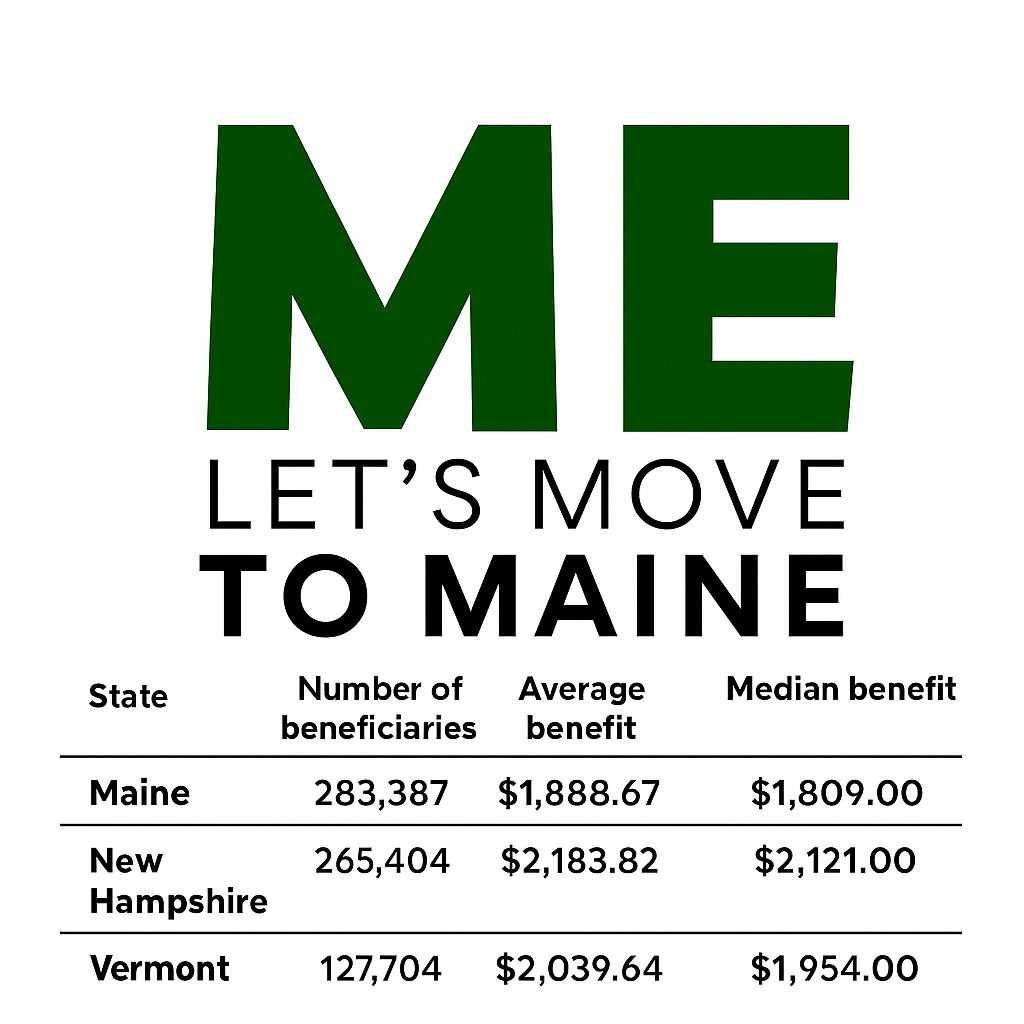
Maine has 283,387 Social Security beneficiaries. The average monthly benefit is $1,888.67, and the median is $1,809.00—a touch lower than in the other Northern New England states of Vermont and New Hampshire.
Why Maine’s average benefit runs lower
Social Security is tied to your lifetime earnings (indexed for inflation), not where you live now. Maine’s historic wage base has trailed New Hampshire’s and, in many sectors, Vermont’s—so retirees with long Maine-based careers often see slightly smaller checks. Inflow from service, healthcare, education, and seasonal industries also skews benefits modestly lower than states with larger concentrations of high-paying tech/finance jobs.
Can you live comfortably on ~$1,889/month? It depends heavily on location and lifestyle.
- Housing: Coastal hot spots (Portland, southern beaches, Mount Desert Island) command premium rents and home prices. Inland and northern markets—Bangor area, central lakes region, the Kennebec Valley, and Aroostook County—offer far more affordable options. Many newcomers target small towns just outside job centers (e.g., greater Lewiston–Auburn or Brewer/Hermon near Bangor) to balance access and cost.
- Utilities & winter fuel: Plan intentionally for heating costs (oil, propane, or heat pumps). A well-insulated home or one upgraded with a heat pump can materially trim winter bills—an important quality-of-life factor on a fixed income.
- Taxes: Maine does not tax Social Security benefits. Property tax relief programs (e.g., Homestead Exemption and the Property Tax Fairness Credit) can further ease annual costs for eligible homeowners.
- Healthcare: Access is strongest in and around Portland, Bangor, and Lewiston–Auburn, with specialized services concentrated at major hospitals. If routine specialists matter to you, map providers before you pick a town.
- Everyday costs: Groceries and services are similar to much of New England; transportation is modest if you live near essentials, but rural distances add up.
Where the numbers stretch furthest
- Best value towns (representative examples): Brewer, Old Town, Waterville, Skowhegan, Auburn, Sanford, Presque Isle, Caribou.
- Value near the coast: Biddeford/Saco (inland neighborhoods), Belfast, Thomaston/Rockland outskirts, and parts of Downeast just beyond Bar Harbor’s tourist core.
- If you’re buying: Look for tight envelopes (newer construction or recently weatherized homes), modest square footage, and secondary markets within 20–40 minutes of major services.
Practical moves for fixed-income comfort
- Audit the house first. Energy assessments and modest weatherization (air sealing, attic insulation, smart thermostats) can lower winter bills more than almost any other monthly tweak.
- Tap homeowner relief. Explore the Homestead Exemption and Property Tax Fairness Credit if you qualify.
- Shop Medicare carefully. Formularies and provider networks vary by county; an annual review can save real money.
- Consider a housemate or in-law/ADU setup. Multi-generational or roommate arrangements are increasingly common and effective in Maine’s four-season climate.
- Transport trade-offs. Living closer to groceries, clinics, and community hubs can cut car costs substantially.
Bottom line: With an average check around $1,889, Maine can be a very livable retirement—especially if you favor inland or small-city markets, pick an energy-efficient home, and leverage state property-tax relief.