
As spring begins to bloom along the coast of Maine, so too does one of the state's most celebrated natural events: the annual return of the alewife. This small, searun fish, a relative of the Atlantic herring, makes its dramatic migration inland from the Atlantic Ocean to spawn in the freshwater lakes and rivers of Maine, drawing not only the attention of wildlife but also curious onlookers, school groups, and conservationists.
“The alewife run is a harbinger of spring,” said Dr. Theo Willis, a Searun Fish Restoration Coordinator with the Maine Department of Marine Resources (DMR). “Gardeners will notice that alewives arrive in Maine’s rivers with the blooming of the shadbush (Amelanchier arborea), a native berry tree that grows all along the coast.”
From mid-April through late May, these shimmering fish swim upstream in search of calm spawning grounds, often congregating below natural falls, whitewater areas, or dams. “Alewife like to migrate on sunny days,” said Mike Brown, DMR’s head of Fisheries Management and Monitoring for Municipal Harvest. “They stack up below natural falls or any white water in a stream or below dams.”
The spectacle takes place across Maine’s waterways—from small streams like Alewife Brook in Cape Elizabeth to major rivers like the Kennebec and Penobscot. With recent spring rains swelling the rivers and daytime temperatures swinging between the 50s and 70s, experts anticipate an especially strong migration season.
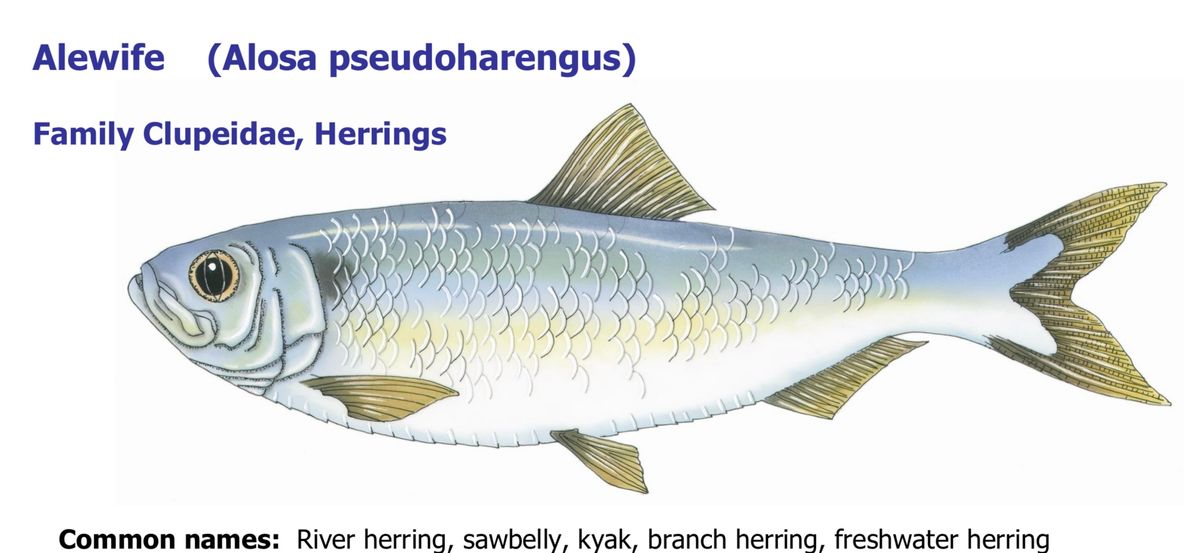
Drawings provided courtesy of the Maine Department of Marine Resources Recreational Fisheries program and the Maine Outdoor Heritage Fund.
Visitors hoping to witness the phenomenon firsthand have several prime locations to choose from. In Westbrook, a popular trail leads to natural viewing areas along the Presumpscot River. Brunswick Dam opens its dedicated viewing room to the public Wednesday through Sunday, 1–5 p.m. Meanwhile, the town of Warren welcomes visitors to Payson Park, where a footbridge offers a vantage point of fish swarming upstream.
“You’ll see a gilded alewife on the town seal of Warren,” noted Dr. Willis. “The fish are so iconic here that they’ve become part of the identity of the community.”
The Blue Hill Peninsula is another hotspot for fish watching, with Walker Pond, Wight Pond, and Pierce Pond drawing both alewives and the predators that follow them—including ospreys and bald eagles.
The migration also provides educational value. Damariscotta Mills, a site steeped in ecological and historical significance, partners with the Nobleboro Historical Society to offer guided tours and learning opportunities for school groups and visitors alike. “This will be the second year that DMR has offered to help schools get kids to local alewife runs,” said Dr. Willis. “We’ve heard that busing is a limitation for most schools, so DMR is offering to help facilitate kids learning about the state’s searun fish heritage by picking up the tab to get classes to places like Damariscotta Mills.”
The alewife’s return is more than a seasonal migration—it’s a celebration of Maine’s environmental heritage, biodiversity, and enduring connection between people and place. As rivers fill with the glimmer of thousands of fish, they also echo with the sounds of spring and the shared wonder of a state coming to life.